Photography Lighting & Exposure
CRI, TLCI, and TM-30 Metrics for Evaluating Continuous Studio LED Panels
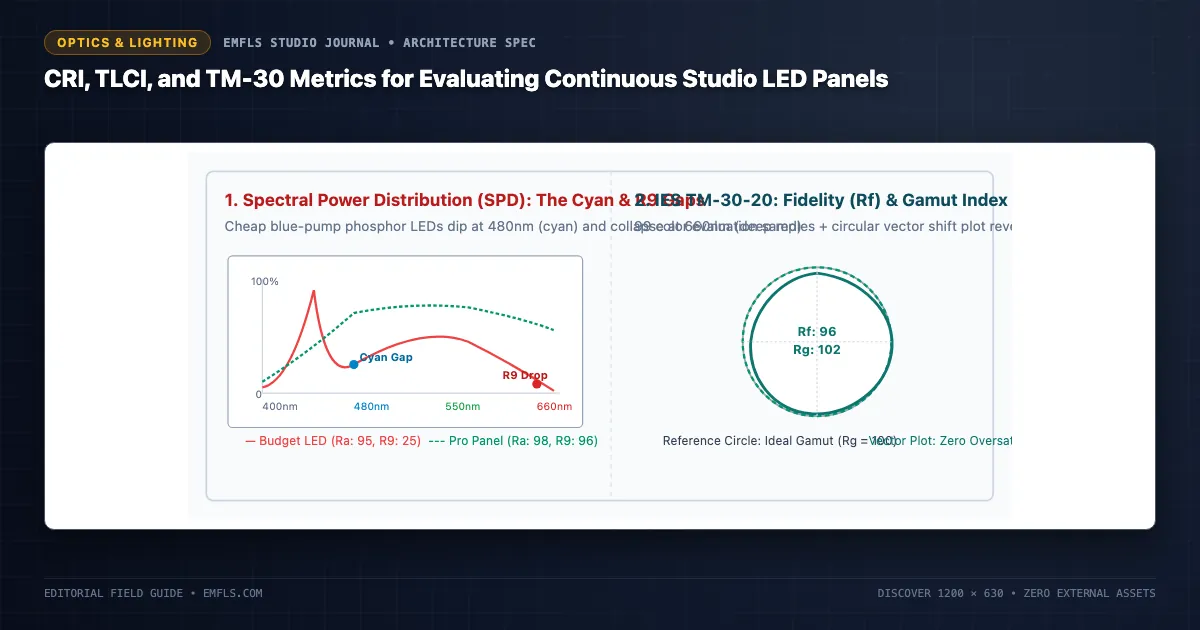
A continuous LED panel claiming a CRI of 95 can still render human skin tones sickly green or muddy orange on a digital camera sensor. Standard CRI averages only eight pastel color swatches, hiding severe deficiencies in deep saturated red (R9) and the notorious cyan gap at 480 nanometers. Auditing studio panels with TLCI and IES TM-30 fidelity and gamut vectors reveals true spectral accuracy before you hit record.
Scroll horizontally or focus the diagram and use the arrow keys to see all labels.
The Deceptive Nature of Marketing CRI in Modern LED Panels
When shopping for continuous lighting to equip a video studio or photography workspace, creators are inundated with manufacturer claims of "CRI > 95+" or "Ultra-High Color Fidelity 98 CRI." Many filmmakers purchase these budget fixtures believing that an impressive score guarantees lifelike skin tones and pristine product color reproduction. Yet when they review footage in the editing suite or inspect raw camera stills, human faces appear unnatural: skin undertones look either sickly yellow-green or deadened and pasty, requiring extensive digital color correction to make talent look healthy.
This baffling discrepancy occurs because the standard Color Rendering Index (CRI, formally designated as Ra) was developed in 1965 by the International Commission on Illumination (CIE) to evaluate fluorescent lighting—decades before light-emitting diodes (LEDs) were invented. The standard Ra metric calculates the arithmetic average of color shifts across only eight past-medium saturation color swatches, labeled R1 through R8. Crucially, all eight baseline swatches are subdued pastel tones: light grayish red, dark grayish yellow, strong yellow green, moderate yellowish green, light greenish blue, light blue, light violet, and light reddish purple.
Because none of the eight test swatches contain highly saturated colors, a manufacturer can design an inexpensive LED using a fierce royal-blue emitter chip coated with standard yellow phosphor that scores an impressive 95 on pastel swatches while completely collapsing when illuminating saturated hues. In digital cinematography and studio photography, the most critical color in human skin reflection is saturated red—which is completely omitted from the basic Ra calculation.
In our studio research on Kelvin white balance calibration and RAW sensor dynamic range, we demonstrated that camera sensors do not possess the adaptive chromatic compensation of the human brain. When a continuous light source lacks key spectral wavelengths, a digital sensor simply registers a blank zero in those photon buckets, making true color recovery in post-production impossible.
The Critical Role of Saturated Red (R9) and the Cyan Gap (480nm)
To expose the limitations of basic CRI, the CIE introduced an extended set of six additional reference swatches numbered R9 through R14. Among these supplemental colors, swatch R9 (saturated solid red) is universally recognized as the single most vital metric for camera work. In human biology, skin is translucent; light penetrates the epidermis and reflects off oxygenated blood vessels in the dermis. If an LED fixture emits weak energy at the 660 nanometer red wavelength, human subjects lose their vibrant skin warmth and look washed out or gray.
Many commercial consumer lights claiming "CRI 95" actually exhibit an R9 rating of only 20 or 30—and occasionally a negative score. For reliable studio portraiture and video recording, an LED panel should possess an independent R9 rating of 90 or greater.
The second major physical flaw in budget white LEDs is the cyan gap between 470 nm and 490 nm. Standard white LEDs produce white light by using a semiconductor die that emits a sharp spike of intense blue light at 450 nm to excite a yellow phosphor coating that glows broadly from 520 nm to 650 nm. In the transitional valley between the blue pump peak and the yellow phosphor emission, optical power plunges dramatically. This cyan deficiency distorts teal fabrics, sky reflections, and skin tone transitions. High-end continuous fixtures solve this by incorporating dedicated cyan and deep red LEDs (five-color RGBWW or RGBAW architectures) to smooth out the spectral curve.
TLCI-2012: The Television Lighting Consistency Index
Recognizing that the human eye and a digital camera sensor perceive color through fundamentally different spectral sensitivity curves, the European Broadcasting Union (EBU) developed the Television Lighting Consistency Index (TLCI-2012), authored by Alan Roberts. While CRI models a standardized human observer, TLCI models the standard optical response of a 3-CCD or Bayer-pattern digital camera sensor paired with a standardized display monitor.
TLCI calculates color deviations on a scale of 0 to 100 using 24 color test swatches derived from the Macbeth ColorChecker chart. It compares the test light source against a mathematical reference illuminant (either a Planckian blackbody radiator or the CIE daylight standard matching the correlated color temperature) and grades the required post-production color grading effort:
- TLCI 85 to 100: Color errors are so small that no color grading is needed. Skin tones and brand colors render faithfully straight out of the camera. Mandatory for broadcast production and professional video studios.
- TLCI 75 to 85: A skilled colorist can achieve acceptable results by applying secondary color correction, though subtle shifts may remain in saturated highlights.
- TLCI 50 to 75: Noticeable color errors requiring extensive color grading. High risk of metameric failure where two fabrics that match in person render as different colors on camera.
- TLCI < 50: Unusable for professional video or photography. Color fidelity cannot be rescued without introducing digital sensor noise and hue artifacts.
The table below summarizes the key differences between the four primary color metrics used to evaluate modern studio LED equipment:
| Evaluation System | Authoring Body | Number of Swatches | Observer Model | Includes Saturated Red? | Minimum Pro Studio Target |
|---|---|---|---|---|---|
| CRI (General Ra) | CIE (1965 / 1974) | 8 pastel swatches (R1–R8) | Human eye (CIE 1931 2°) | No (Saturated red excluded) | Ra ≥ 96 (Insufficient alone) |
| Extended CRI (Re) | CIE (Supplemental) | 15 swatches (R1–R15) | Human eye (CIE 1931 2°) | Yes (R9 saturated red) | Ra ≥ 96 and R9 ≥ 90 |
| TLCI-2012 | EBU (Alan Roberts) | 24 ColorChecker swatches | Bayer camera sensor + D65 display | Yes (Full spectrum balance) | TLCI ≥ 95 (Broadcast grade) |
| IES TM-30-20 | IES Method (2020) | 99 real-world color samples | Human + Multi-angle spectral | Yes (Fidelity Rf + Gamut Rg) | Rf ≥ 95, Rg 98–102 |
IES TM-30-20: The Definitive Two-Dimensional Color Standard
While TLCI represents a major advance for video sensors, the lighting engineering industry has universally embraced IES TM-30-20 (published by the Illuminating Engineering Society) as the most comprehensive color evaluation system ever devised. TM-30 eliminates the flaws of previous metrics by replacing 8 or 24 arbitrary swatches with 99 Color Evaluation Samples (CES) selected from real-world objects: human skin pigments from diverse ethnicities, oil paintings, botanicals, synthetic fabrics, and consumer packaging.
Crucially, TM-30 recognizes that color rendering is not a single one-dimensional number. An LED fixture can maintain accurate color neutrality while dulling or oversaturating specific hues. To capture this complexity, TM-30 delivers two complementary metrics accompanied by a visual vector graphic:
- Fidelity Index (Rf): Evaluates how closely the test light reproduces the exact appearance of the 99 samples compared to a reference illuminant on a scale of 0 to 100. It behaves like an ultra-accurate version of CRI, but is completely immune to spectral cherry-picking.
- Gamut Index (Rg): Measures whether the light source increases or decreases the overall saturation (gamut area) of colors across the 16 hue bins. An Rg score of 100 indicates identical average saturation to the reference. An Rg > 100 indicates that colors appear more vivid and punchy, while an Rg < 100 indicates desaturation.
- Color Vector Graphic: A circular 16-hue polar plot. A black dotted circle represents the ideal reference light. A solid colored ring displays the test light. Arrows pointing outward indicate that a specific color range is being oversaturated; arrows pointing inward indicate desaturation. Shifts clockwise or counterclockwise reveal hue tinting (such as red shifting toward orange or blue shifting toward violet).
When reviewing lighting manufacturer spec sheets, look for fixtures that provide an Rf of 95 or higher and an Rg between 98 and 102. An Rg of 108 may look appealing to the naked eye in an interior showroom, but on camera, oversaturated red and green channels will clip during high-key product shoots, making highlight detail difficult to recover as explained in our guide on tabletop shadow control.
Field Testing: How to Audit Your LED Panels with a Spectrometer
Do not rely exclusively on box marketing. If your studio regularly shoots commercial video, client interviews, or precision color work, audit your lighting assets using an optical spectrometer (such as a Sekonic C-7000 or C-800 series spectroradiometer). Follow this four-step field audit procedure:
- Warm-Up Stabilization: Power on the LED panel and let it run at 100% output for at least 15 minutes before taking measurements. Solid-state LEDs experience thermal drift as junction temperatures rise, shifting correlated color temperature (CCT) by 100K to 300K and degrading R9 as heat sink dissipation stabilizes.
- Dimming Curve Inspection: Measure CCT, CRI, and TLCI at 100%, 50%, 25%, and 10% output power. High-grade studio fixtures use pulse-width modulation (PWM) or precision digital current reduction that maintains color metrics across the dimming range. Cheap panels frequently drift cooler (blue shift) or lose 10+ points of R9 at low power settings.
- Modifier Absorption Checks: Take a baseline measurement of the bare LED panel, and then take a secondary reading through your front diffusion fabric, softbox, or honeycomb grid. Many budget nylon diffusers contain chemical optical brighteners that absorb ultraviolet and violet light and re-emit blue photons, shifting your carefully calibrated 5600K key light to a harsh 6100K with negative green tint.
- ColorChecker Camera Calibration: Place an X-Rite ColorChecker Classic in the lit subject plane and shoot a raw photograph. In Adobe Lightroom or DaVinci Resolve, generate an input camera profile. If the delta-E color error across the 24 patches exceeds 2.5, your light source possesses spectral gaps that require custom profiling.
Frequently Asked Questions About Studio LED Color Quality
Can I fix low-CRI lighting by adjusting white balance or tint in camera?
No. White balance and tint adjustments operate globally along two linear color axes: the Kelvin blue-amber axis and the green-magenta tint axis. A low-CRI light with a missing R9 red band or a cyan valley represents a physical spectral gap in the emitted photons. Shifting global tint toward magenta to compensate for green casts simply turns your background and shadows magenta while leaving the skin tones muddied. You cannot amplify wavelengths that were never emitted by the light fixture.
What is the difference between bi-color LEDs and RGBWW LED panels?
Bi-color panels use two types of white LED phosphor beads: warm white (typically 2700K or 3200K) and cool white (typically 5600K or 6500K). Intermediate color temperatures are created by cross-fading power between the two sets. RGBWW panels add three saturated color emitters (Red, Green, Blue) alongside high-CRI Warm White and Cool White beads. High-end RGBWW panels use the additional color chips to actively fill in the spectral cyan and red gaps across the entire CCT spectrum, resulting in superior TLCI and TM-30 scores.
Is a high TLCI score always better than a high CRI score for video?
Yes. TLCI-2012 was specifically engineered around the optical spectral response of digital video camera sensors. A light source with a TLCI of 98 guarantees that a digital cinema or mirrorless camera will capture natural colors requiring minimal secondary grading. Standard CRI (Ra) only measures human vision under pastel swatches, making it an unreliable indicator of digital video fidelity.
Why do some LED lights cause banding or flicker at high shutter speeds?
Continuous LED fixtures control brightness through Pulse-Width Modulation (PWM), rapidly pulsing the light on and off thousands of times per second. If the PWM frequency is too low (e.g., 1 kHz to 5 kHz), the camera rolling shutter captures different light levels across sequential sensor lines, resulting in dark horizontal bands. Studio-grade LED panels utilize high-frequency PWM (above 25 kHz) or continuous DC ripple-free drivers that remain completely flicker-free at high frame rates up to 1,000 frames per second.
Frequently Asked Questions
Can I fix low-CRI lighting by adjusting white balance or tint in camera?
No. White balance and tint adjustments operate globally along two linear axes. A low-CRI light with missing red (R9) or cyan energy represents a physical spectral gap. Shifting global tint simply stains your shadows without recovering missing photon wavelengths.
What is the difference between bi-color LEDs and RGBWW LED panels?
Bi-color panels cross-fade between warm and cool white LEDs. RGBWW panels incorporate saturated red, green, and blue emitters alongside warm and cool white diodes, allowing the driver to actively fill in cyan and deep-red spectral valleys for higher TLCI and TM-30 scores.
Is a high TLCI score always better than a high CRI score for video?
Yes. TLCI-2012 was specifically calibrated around the spectral sensitivities of digital camera sensors and Bayer color filter arrays, whereas standard CRI (Ra) evaluates human vision across pastel swatches, omitting critical saturated skin pigments.
Why do some LED lights cause banding or flicker at high shutter speeds?
Continuous LED panels dim using Pulse-Width Modulation (PWM). If the PWM switching frequency is too low, the camera rolling shutter captures varying exposures across sensor scanlines, producing horizontal bands. Pro fixtures utilize high-frequency PWM (25kHz+) or ripple-free DC current.